
Guides › Opening Balances: How to Prepare and Account for Them
Opening Balances: How to Prepare and Account for Them
RBTERP team · · 4 min read
How to prepare your opening position for a new accounting system: what to collect, how to check it, and how each balance is accounted for on day one.
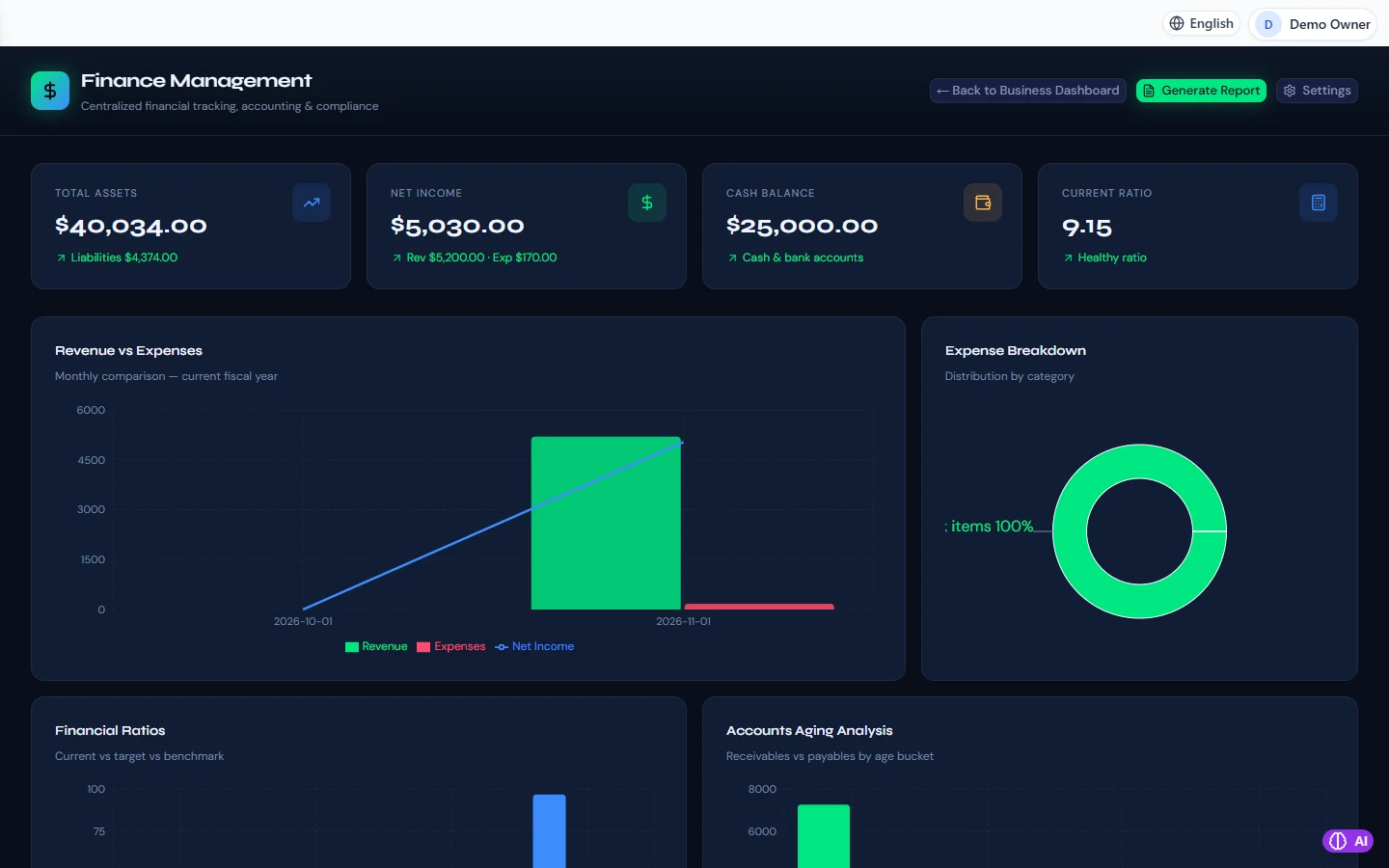
Finance & Accounting in RBTERP, with a sample company and fictional data.
Opening balances are your business's financial position on the day the new system takes over. Get them right and every report from day one is trustworthy. Get them wrong and every report carries the error until someone finds it, usually at year-end.
Choose the date first
Everything is measured at one date, the cutover date: the last day your old records cover. Choose a month-end, and ideally a quarter-end or year-end, when your balances are checked anyway. Transactions up to and including that day stay in the old records. Everything after it is entered in RBTERP.
What to prepare
Prepare each item as a list with a total, and keep the evidence for the total.
Customers who owe you
A list of every unpaid or part-paid invoice: customer, invoice number, date, amount still owed. Not one total per customer. You will need the individual invoices to match payments against, and to see which are overdue. Ask customers with large balances to confirm them.
Suppliers you owe
The same, from the supplier side: every unpaid bill with its number, date and amount. Compare it with supplier statements.
Stock
Count it. For each product in each warehouse, record the quantity and its cost. Value stock at what it cost you, not at selling price.
Bank and cash
For each account, the balance in your books on the cutover date, reconciled to the bank statement. Keep the list of cheques not yet cleared and deposits not yet credited. See bank reconciliation, step by step.
Everything else
A trial balance on the cutover date for all other accounts: fixed assets and their accumulated depreciation, loans, tax payable, accruals, the owners' capital and retained profit.
How each balance is accounted for
Every opening entry has two sides, like any other entry. The question is what the other side is.
- Opening receivables are debited to accounts receivable.
- Opening payables are credited to accounts payable.
- Opening stock is debited to inventory, at cost.
- Bank balances are debited, or credited for an overdraft, to the bank accounts.
The other side of each of these goes to a temporary account called Opening Balance Equity. Then the trial balance is loaded for every account not already loaded in detail, again against Opening Balance Equity.
Here is the check that makes the method work: once everything is in, Opening Balance Equity must come to exactly zero. The detail you loaded and the trial balance describe the same position from two directions. If anything is left on that account, it is precisely the total of what does not agree yet.
The checks before you go live
- Total receivables equal the list of open customer invoices.
- Total payables equal the list of open supplier bills.
- Stock value equals the counted stock at cost.
- Each bank balance equals your reconciled book balance.
- Every other account agrees with the old trial balance.
- Opening Balance Equity is zero.
Do not enter live transactions until all six hold. A difference traced on day one takes minutes; the same difference three months later takes days.
Doing it in RBTERP
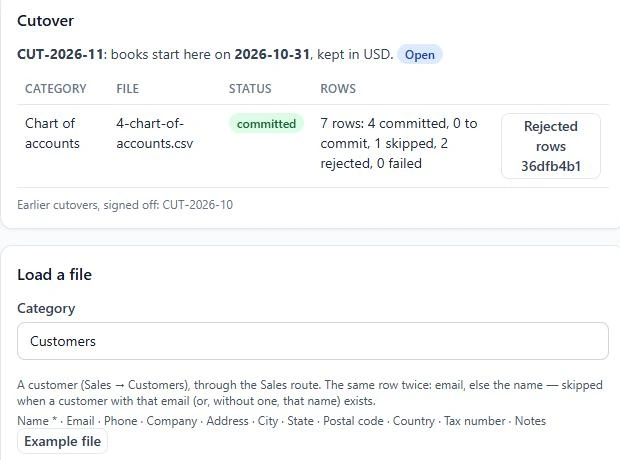
RBTERP's data migration screen, under Settings, is built around this exact method.
- Open a cutover with a reference and the cutover date. The month of that date must be open.
- Load the files in order: customers, suppliers, products, chart of accounts, open customer invoices, open supplier invoices, inventory on hand, bank balances, and the trial balance last. Each category has an example file showing its columns.
- Read the rejects. Files are checked strictly: a spreadsheet formula, an unreadable character, an ambiguous date, money with more than two decimals or a document in another currency without its rate is rejected with the reason, never silently changed. Fix and load again; rows already loaded are skipped.
- Every opening entry is dated the cutover date and posted against Opening Balance Equity, account 3950 or the account you map to that role.
- When Opening Balance Equity nets to zero and the checks above agree, have a second person sign off.
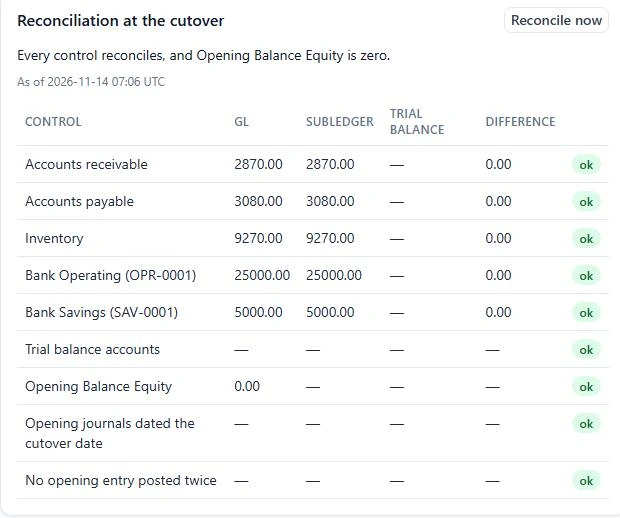
Moving from Excel to an ERP covers cleaning spreadsheet data before you load it. If you would like us to do this for you, the Full Account Setup service covers the chart of accounts, opening balances, open receivables and payables, opening stock and the trial balance reconciliation.