
Guides › Bills of Materials and Work Orders
Bills of Materials and Work Orders
RBTERP team · · 3 min read
How to define what goes into a product with a bill of materials, plan production with work orders, and account for materials, scrap and finished goods.
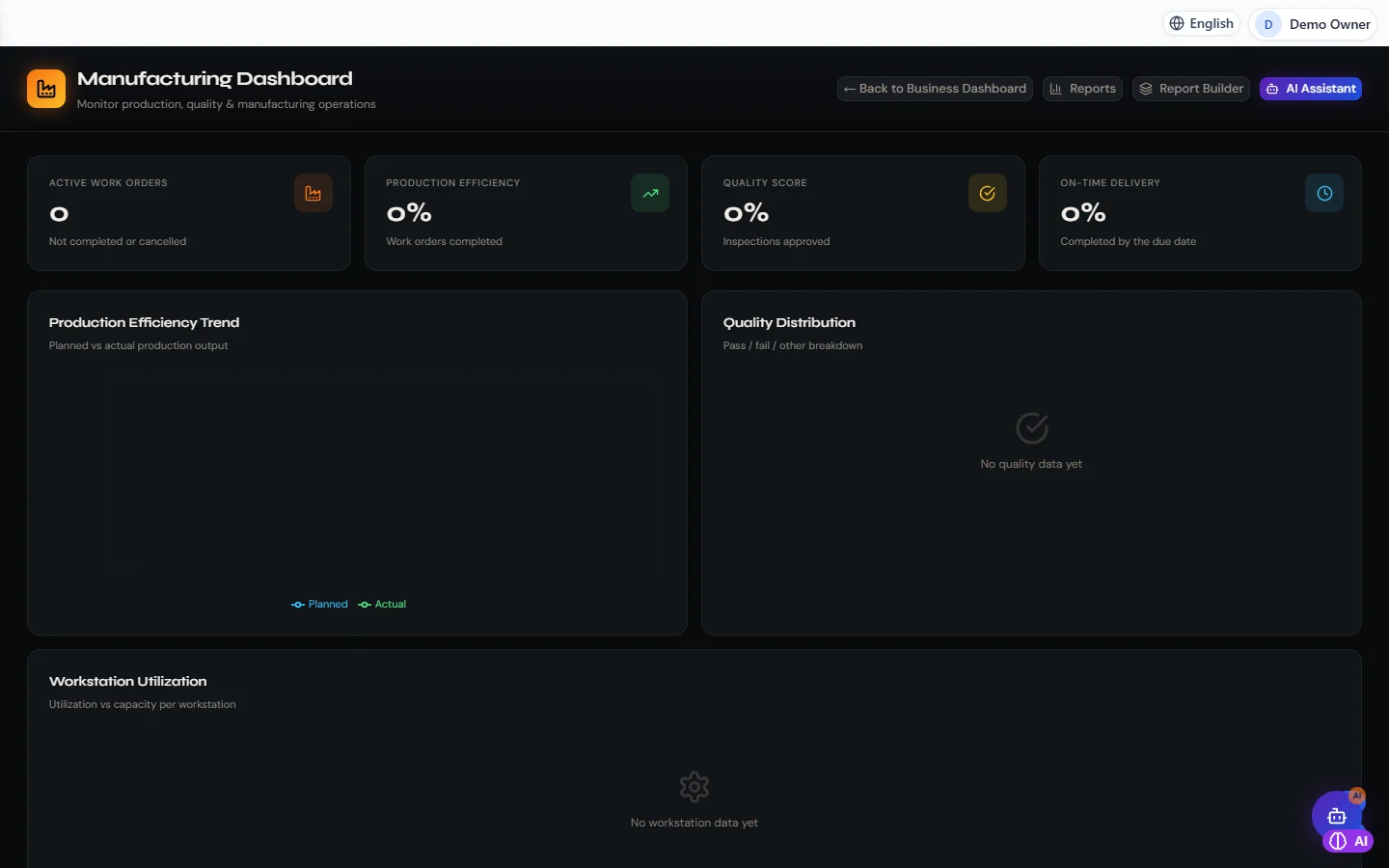
Manufacturing in RBTERP, with a sample company and fictional data.
Manufacturing turns materials into products. To control it, you need to know what each product is made of, what you plan to make, and what was actually used. The bill of materials and the work order are the two documents that do this.
The bill of materials
A bill of materials, or BOM, is a recipe. For one unit of a finished product, it lists:
- Each component or material, and the quantity needed.
- An allowance for scrap: material lost in cutting, trimming or testing, as a percentage.
Example, for one wooden table: four legs, one top, sixteen screws, 0.2 litres of varnish, with 5% scrap on the varnish.
Good BOMs are:
- Accurate. Measure real usage, not what the design assumes.
- Specific. Each component is a product with its own code and cost.
- Versioned. When the recipe changes, create a new revision rather than editing the old one, so past production still makes sense.
The work order
A work order is an instruction to produce a quantity of one product by a date, using a particular BOM. It tells the shop floor what to make, and tells the store what materials to issue.
Its life:
- Planned: you intend to make it.
- Released: materials are checked and work can start.
- In progress: being made, with labour and machine time recorded.
- Completed: finished goods are received into stock.
Check materials before you start
Before releasing a work order, compare the materials the BOM needs for that quantity with what is on hand. Starting a job without the materials means a half-finished order on the shop floor and a late delivery to the customer. Planning materials across all open orders this way is called material requirements planning, or MRP.
How production is accounted for
When a work order is completed:
- Materials leave stock at their cost: the BOM quantity × the order quantity, plus the scrap allowance.
- Finished goods enter stock at the cost of the materials consumed.
The value moves from raw materials into finished goods; nothing is lost from the books. Scrap beyond the allowance is recorded separately as a loss, so you can see it.
Manufacturing in RBTERP
- Completion backflushes the BOM, exactly once. Moving a work order to *completed* issues every stocked BOM line, quantity × order quantity × (1 + scrap %), through the inventory stock ledger, and receives the finished goods at the material cost consumed.
- Changes are reversed cleanly. Moving an order out of *completed*, or changing what it produced, reverses the earlier run and applies the new one. Deleting a completed order reverses it first.
- Stock is checked, never driven negative. Completion is refused with what is short and how much is on hand. A refusal moves nothing.
- The newest active BOM of the product is used when an order names none. A BOM belongs to one product; a product cannot be its own component; a BOM that an open order is building from cannot be deleted.
- Scrap leaves stock at the cost it carried, booked to inventory shrinkage. A locked period refuses it.
- MRP lists the needs of open orders' BOMs against stock on hand. Free-text materials are listed as not stocked, never as short.
- Progress of a work order is the share of its job cards completed. Labour efficiency and cost come from hours, and subcontract value from quantity × unit price.
Measure how well production runs with quality inspections and production efficiency. For how finished goods are valued, see inventory valuation at cost.
This guide uses the Manufacturing module of RBTERP: Work orders, production efficiency, quality inspections and workstation utilisation.